
The Rise of AI in Creative Production: Revolutionizing Brand Storytelling
- Canute Fernandes
- Jun 2
- 7 min read

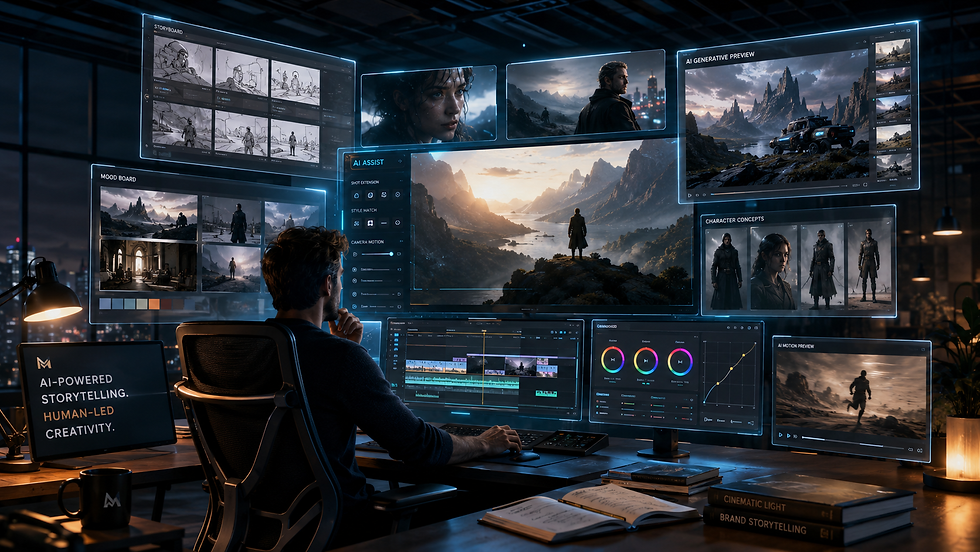
AI in creative production is changing how brands plan, produce, edit, and distribute cinematic content. The biggest shift is not that AI is replacing creative teams. It is that AI is compressing the mechanical parts of production so human creatives can spend more time on strategy, taste, emotion, and story.
For brands, this matters because content demand keeps rising. Campaigns now need hero films, paid social cutdowns, vertical edits, product explainers, founder-led clips, localization, thumbnails, motion graphics, and platform-specific variations. Generative AI gives production teams a faster way to develop concepts, test visual directions, adapt assets, and scale campaigns without starting from zero every time.
But AI does not remove the need for creative judgment. The best AI-assisted production workflows are human-led. AI can accelerate scripting, mood boarding, previsualization, rough edits, and versioning, but people still need to define the message, protect the brand voice, approve the final story, and make ethical decisions about disclosure, consent, and authenticity.
Why AI in Creative Production Matters Now
Generative AI is moving from experimentation into everyday creative operations. Google has described generative AI as a way to unlock new possibilities across the marketing process, including creative asset generation and visual storytelling at scale. Adobe has similarly positioned AI as a way for creative teams to scale content while maintaining message control.
For production companies and brand teams, the opportunity is practical: faster concept development, more efficient pre-production, richer pitch materials, smoother post-production, and more versions of finished assets for different channels.
McKinsey’s analysis of generative AI in entertainment points to a wider shift across the content creation value chain, including previsualization, postproduction, new production processes, and changing economics in video production. Brand marketers do not need to wait for the entire industry to settle before acting. They need a clear operating model for using AI responsibly now.
What Is AI-Assisted Creative Production?
AI-assisted creative production is the use of artificial intelligence tools to support the creative workflow from concept to delivery. This can include idea generation, script drafts, visual references, synthetic footage, shot planning, editing support, color matching, audio cleanup, translation, localization, resizing, and performance-informed content variations.
The key word is assist. AI can generate options, but it cannot own the brand strategy. It can produce visual possibilities, but it cannot decide which one feels emotionally true. It can speed up production, but it cannot replace taste, context, experience, or accountability.
A strong AI production workflow keeps humans in control of:
Production Decision | AI Can Help With | Human Must Own |
Brand strategy | Research summaries, audience prompts | Positioning, message, campaign goal |
Concepting | Mood boards, visual routes, references | Creative direction and originality |
Scriptwriting | First drafts, alternates, hooks | Voice, accuracy, emotional arc |
Previsualization | Synthetic scenes, animatics, test frames | Shot selection and feasibility |
Editing | Rough cuts, transcripts, versioning | Rhythm, story, pacing |
Distribution | Format adaptation, metadata drafts | Channel strategy and final approval |
Ethics | Disclosure prompts, rights checklists | Consent, legal review, transparency |
How AI Is Reshaping the Production Lifecycle
1. Strategy and Briefing
AI can help teams move from a loose idea to a sharper creative brief. It can summarize audience insights, compare campaign angles, generate messaging territories, and identify content variations for different channels.
But this is only useful when the brand has already defined its foundations: audience, offer, tone, visual identity, emotional target, and business objective. AI cannot fix an unclear strategy. It can only multiply it.
2. Pre-Production
Pre-production is one of the strongest use cases for AI in creative production. Teams can use AI to generate mood boards, visual references, sample frames, location concepts, rough scripts, storyboard options, and pitch treatments.
This helps brands evaluate creative directions before committing to production costs. It also makes alignment easier between internal marketing teams, agencies, directors, editors, and production partners.
3. Production
On set, AI can support planning, continuity, shot logging, transcription, and production management. It can help teams organize footage, identify usable clips faster, and reduce the risk of missing key material.
For cinematic brand work, however, AI should not flatten the production process into automation. Lighting, performance, framing, texture, timing, and human presence still matter. The most compelling work often comes from a hybrid approach: real cinematography enhanced by AI-supported planning and post-production.
4. Post-Production
Post-production is where AI can create major efficiency gains. AI tools can assist with transcription, rough-cut assembly, audio cleanup, color matching, object removal, captioning, translation, and platform-specific resizing.
This does not make editors less important. It makes editorial judgment more important. When AI removes repetitive tasks, editors can focus on pacing, emotional rhythm, visual coherence, and whether the final film actually lands.
5. Distribution and Versioning
Modern campaigns rarely rely on one finished asset. A single brand film may need versions for YouTube, LinkedIn, Instagram Reels, TikTok, paid ads, website hero sections, email, sales decks, and event screens.
AI-assisted versioning can help production teams adapt aspect ratios, durations, captions, thumbnails, voiceovers, and localized variations. This is where AI can reduce the marginal cost of content without reducing the quality of the core idea.
Generative AI Video and the New Economics of Brand Storytelling
Generative AI video changes what brands can prototype. A concept that once required a full shoot can now be explored visually before the production budget is committed. Teams can test mood, movement, composition, transitions, and surreal or speculative visuals earlier in the process.
This is especially valuable for challenger brands, founder-led companies, and mid-market businesses that need cinematic content but may not have enterprise-level production budgets.
However, easier production does not automatically mean better storytelling. When everyone can generate polished visuals, the advantage shifts to strategy: sharper positioning, more specific narrative choices, stronger emotional hooks, and a clearer brand point of view.
AI can help a brand produce more. It cannot decide what is worth saying.
Protecting Brand Voice in AI-Assisted Production
The biggest creative risk with AI is not technical failure. It is generic output.
Generative systems tend to produce content that feels statistically familiar unless they are guided by strong creative constraints. That means brands need guardrails before they scale AI-assisted production.
A practical brand AI production system should include:
Guardrail | Purpose |
Approved visual references | Keeps generated concepts aligned with the brand world |
Tone-of-voice rules | Prevents generic or off-brand scripts |
Negative prompts / exclusions | Defines what the brand should avoid |
Human approval stages | Keeps accountability with creative leads |
Rights and consent checklist | Reduces legal and reputational risk |
Disclosure policy | Clarifies when and how AI use should be communicated |
Asset provenance record | Tracks what was generated, edited, licensed, or shot |
This is where human-in-the-loop production becomes essential. The AI can generate options. The creative team decides what is usable, distinctive, ethical, and brand-right.
Ethical and Legal Considerations for AI Brand Content
AI-assisted production raises real questions around transparency, authorship, ownership, likeness rights, and audience trust.
The U.S. Copyright Office has published guidance for works containing AI-generated material, and brands should treat copyright review as part of the production process when AI-generated assets are used. In the EU, AI Act transparency rules include requirements around identifiable AI-generated content and clear labeling for certain content such as deepfakes, with transparency rules scheduled to come into effect in August 2026.
Brands should also consider provenance tools. C2PA describes Content Credentials as a standard that works like a “nutrition label” for digital content, helping people inspect content history and origin.
A responsible AI production policy should answer five questions before publication:
Was any part of the visual, voice, likeness, or performance AI-generated?
Do we have the rights to use all generated, licensed, and captured assets?
Could the content mislead viewers about what is real?
Should the AI-generated element be disclosed?
Who signs off creatively, legally, and commercially?
How Brands Should Start Using AI in Creative Production
Brands do not need to overhaul their entire production model at once. The safest path is phased adoption.
Phase 1: Use AI in Pre-Production
Start with scripts, mood boards, visual references, storyboard options, and pitch treatments. This is lower risk and high value because it improves clarity before money is spent on production.
Phase 2: Use AI in Post-Production Support
Add AI for transcription, editing assistance, captioning, resizing, audio cleanup, and asset organization. These workflows improve efficiency without handing over creative control.
Phase 3: Use AI for Campaign Versioning
Once the core film is approved, use AI-assisted workflows to create platform-specific versions. This helps teams meet channel demand while keeping the central story consistent.
Phase 4: Test Generative Video Selectively
Use generative AI video for concept prototypes, surreal visuals, scene extensions, or brand worlds that would be difficult to capture physically. Keep human direction and final review at the center.
AI and Search Visibility: What Brands Should Know
AI search visibility is not achieved through secret markup or AI-only tricks. Google says its existing SEO best practices remain relevant for AI features such as AI Overviews and AI Mode, and there are no additional requirements or special optimizations needed to appear in them.
That means this article should be built for clarity, helpfulness, and trust. Google’s guidance emphasizes helpful, reliable, people-first content created to benefit users rather than manipulate rankings.
For this topic, that means:
Use clear definitions.
Answer common questions directly.
Cite credible sources.
Explain risks honestly.
Avoid exaggerated claims.
Show practical examples.
Keep brand recommendations grounded in real production decisions.
Key Takeaways
AI in creative production is not replacing creative vision. It is changing where creative time is spent.
The strongest brands will use AI to accelerate research, concepting, editing, and versioning while keeping human teams in control of story, taste, ethics, and final approval.
Generative AI video can lower barriers to cinematic storytelling, but it does not automatically create originality. As production becomes easier, strategy becomes more important.
Brands should adopt AI with clear guardrails: brand voice rules, human review, rights checks, disclosure standards, and asset provenance.
The winning model is not AI-first or human-only. It is human-led, AI-assisted creative production.
If your brand needs cinematic content at higher speed and scale, start by auditing your current production workflow. Identify where AI can remove friction, then protect the creative decisions that make your brand worth watching.
Comments